Working with large datasets (100K-1M records) for consulting and analysis presents unique challenges. Traditional approaches often fall short when you need to extract the top 100 themes, generate insights, and produce enterprise-quality reports.
This post documents our approach using Claude Code for a real enterprise project: generating biweekly media monitoring reports from 25,000+ news articles across global markets.
The Problem: Large-Scale Data Analysis
The core challenge: given a massive dataset, how do you:
- Identify the top themes and topics
- Deduplicate similar content
- Categorize and rank by business relevance
- Generate summaries without hallucinations
- Produce formatted reports (Excel, PDF)
Three approaches exist. Two don't work well. One does.
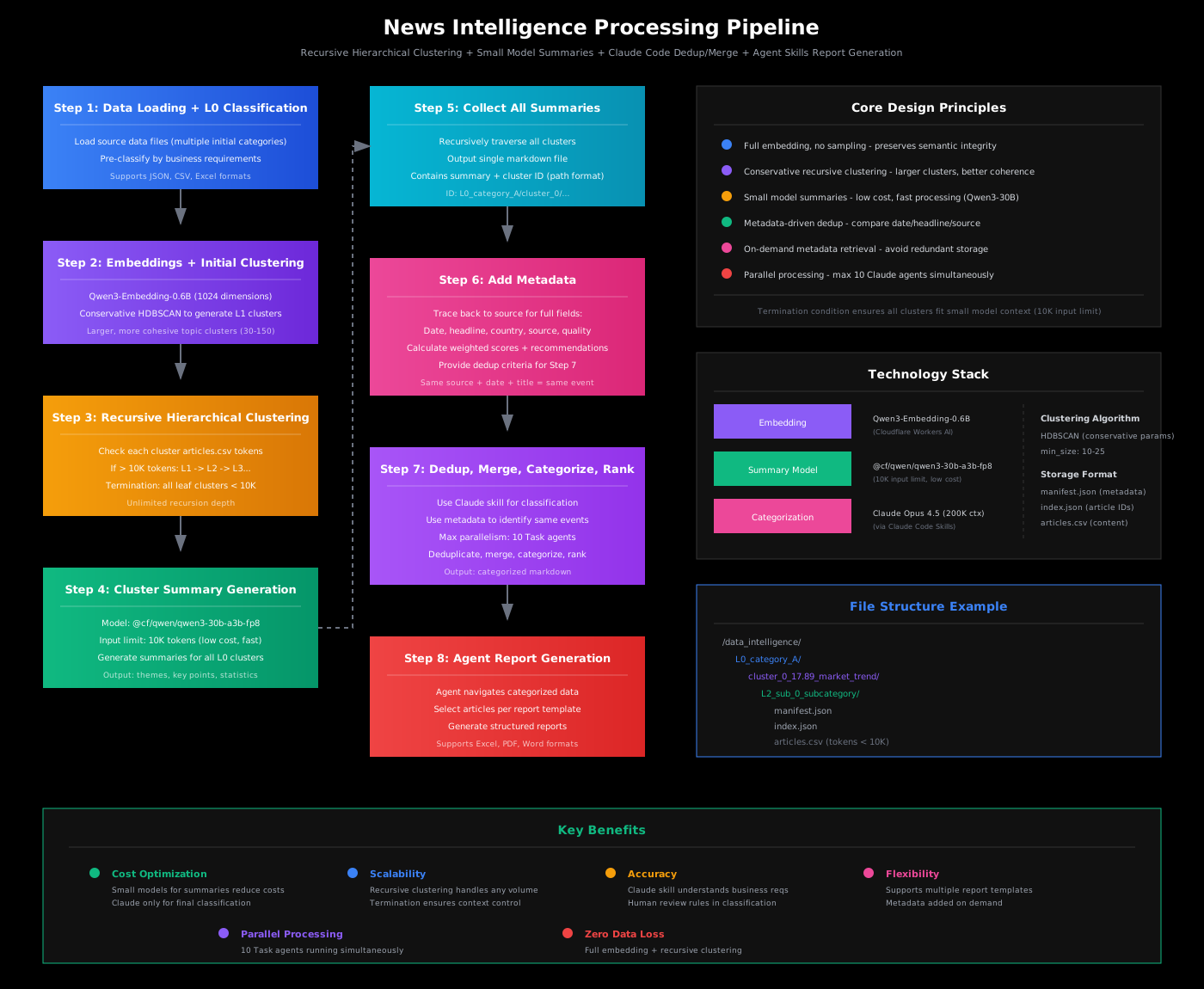
Approach 1: Embeddings + Clustering
The traditional machine learning approach:
- Generate semantic embeddings (e.g., Qwen3-Embedding-0.6B)
- Run density-based clustering (HDBSCAN)
- Recursively sub-cluster until manageable sizes
- Use small models for cluster summaries
处理大规模数据集(10万-100万条记录)进行咨询和分析面临独特挑战。当你需要提取前100个主题、生成洞察并产出企业级报告时,传统方法往往力不从心。
本文记录了我们使用 Claude Code 完成一个真实企业项目的方法:从全球市场的2.5万多篇新闻文章中生成双周舆情监测报告。
问题:大规模数据分析
核心挑战:给定一个海量数据集,如何:
- 识别顶级主题和话题
- 对相似内容去重
- 按业务相关性分类和排序
- 生成摘要且不产生幻觉
- 产出格式化报告(Excel、PDF)
存在三种方法。两种效果不佳。一种有效。
方法一:嵌入向量 + 聚类
传统的机器学习方法:
- 生成语义嵌入向量(如 Qwen3-Embedding-0.6B)
- 运行基于密度的聚类(HDBSCAN)
- 递归子聚类直到可管理的规模
- 使用小模型生成簇摘要
Raw JSON Data (25K articles)
    ↓ [Qwen3-Embedding-0.6B, 1024 dims]
Embedding Vectors
    ↓ [HDBSCAN, conservative params]
L1 Clusters (30-150 clusters)
    ↓ [Recursive if > 10K tokens]
L2/L3 Sub-clusters
    ↓ [Qwen3-30B summaries]
Cluster Summaries
Why it fails: News data is sparse, not dense. HDBSCAN works well when data naturally forms clusters. But news articles cover diverse topics with weak semantic connections.
Results:
- 50%+ articles remain unclustered
- Aggressive parameters create too many micro-clusters
- Even optimized, 30%+ unclustered records persist
When data is sparse, clustering doesn't work.
Approach 2: Large Context LLMs
Modern LLMs have massive context windows:
- Claude Opus 4.5: 200K tokens
- Gemini 3 Pro: 1M tokens
Strategies to fit large datasets:
- Sampling: Take 10% of data to fit within context
- Chunking: Split into multiple sub-datasets, process separately
失败原因: 新闻数据是稀疏的,而非稠密的。HDBSCAN 在数据自然形成簇时效果好。但新闻文章涵盖多样主题,语义关联较弱。
结果:
- 50%以上的文章无法聚类
- 激进的参数会创建太多微型簇
- 即使优化后,仍有30%以上的记录无法归类
当数据稀疏时,聚类不起作用。
方法二:大上下文 LLM
现代 LLM 拥有巨大的上下文窗口:
- Claude Opus 4.5:20万 token
- Gemini 3 Pro:100万 token
容纳大数据集的策略:
- 采样:取10%的数据以适应上下文
- 分块:拆分成多个子数据集,分别处理
Why it fails: Hallucination compounds with context length.
As token consumption grows, the model's attention to facts weakens. Errors accumulate:
- Dates shift
- Numbers drift
- Sources get confused
- Fabricated details appear
Large context is necessary but insufficient. You need verification mechanisms.
Approach 3: Treat It as Codebase File Editing
This is the key insight: coding agents like Claude Code are optimized for file operations.
Claude Code has:
Readtool optimized for files up to 2000 linesEdittool for surgical changesWritetool for file creationBashfor unix commands- Familiar filesystem navigation
The reframe: convert your dataset problem into a codebase problem.
失败原因: 幻觉随上下文长度累积。
随着 token 消耗增长,模型对事实的注意力减弱。错误不断累积:
- 日期偏移
- 数字漂移
- 来源混淆
- 虚构细节出现
大上下文是必要的,但不充分。你需要验证机制。
方法三:当作代码库文件编辑问题处理
这是关键洞察:像 Claude Code 这样的编程智能体针对文件操作做了优化。
Claude Code 拥有:
Read工具,针对2000行以内的文件优化Edit工具用于精确修改Write工具用于文件创建Bash用于 unix 命令- 熟悉的文件系统导航
重新定义问题:将数据集问题转换为代码库问题。
Excel/JSON Data
    ↓ [Preprocessing scripts]
CSV Files (row-based, compact format)
    ↓ [Split into chunks]
200 lines per file × N files
    ↓ [Claude Code operates on files]
Tagged/Labeled/Merged CSV Files
The Conversion
- Dump data to CSV: Export from Excel/JSON to row-based CSV
- Preprocess: Remove whitespace, normalize to compact format
- Chunk: Split into files of ~200 records each (fits in 2000 lines)
- Treat as code: Now working with CSV files is like working with source code
A 200K record dataset becomes ~1000 CSV files. This is normal codebase size. Claude Code handles this naturally.
Example: Labeling at Scale
转换方法
- 导出为 CSV:从 Excel/JSON 导出为行式 CSV
- 预处理:移除空白,规范化为紧凑格式
- 分块:拆分成每个约200条记录的文件(适配2000行限制)
- 当作代码:现在操作 CSV 文件就像操作源代码
一个20万条记录的数据集变成约1000个 CSV 文件。这是正常的代码库规模。Claude Code 自然地处理这些。
示例:大规模标注
- Column A|Column B|...
+ Tag1,Tag2,Tag3|Column A|Column B|...
Claude Code edits each CSV file, adding classification tags to each row. The operation is familiar - it's just file editing.
Parallel Task Agents
Claude Code can run up to 10 Task agents simultaneously. For labeling tasks, assign one agent per CSV chunk:
Claude Code 编辑每个 CSV 文件,为每行添加分类标签。这个操作很熟悉——只是文件编辑而已。
并行 Task 智能体
Claude Code 可以同时运行最多10个 Task 智能体。对于标注任务,为每个 CSV 块分配一个智能体:
Running 10 Task agents... (ctrl+o to expand)
   ├─ Tag batch 1 summaries · 12 tool uses
   │  ⎿  Processing summary_01.csv...
   ├─ Tag batch 2 summaries · 8 tool uses
   │  ⎿  Processing summary_02.csv...
   ├─ Tag batch 3 summaries · 15 tool uses
   │  ⎿  Processing summary_03.csv...
   ├─ Tag batch 4 summaries · 11 tool uses
   │  ⎿  Processing summary_04.csv...
   ├─ Tag batch 5 summaries · 9 tool uses
   │  ⎿  Processing summary_05.csv...
   ├─ Tag batch 6 summaries · 14 tool uses
   │  ⎿  Processing summary_06.csv...
   ├─ Tag batch 7 summaries · 7 tool uses
   │  ⎿  Processing summary_07.csv...
   ├─ Tag batch 8 summaries · 13 tool uses
   │  ⎿  Processing summary_08.csv...
   ├─ Tag batch 9 summaries · 10 tool uses
   │  ⎿  Processing summary_09.csv...
   └─ Tag batch 10 summaries · 6 tool uses
      ⎿  Processing summary_10.csv...
This is 10x parallelism for data processing tasks. The Task tool is one of Claude Code's most powerful features for consulting work.
The IR Workflow Pattern
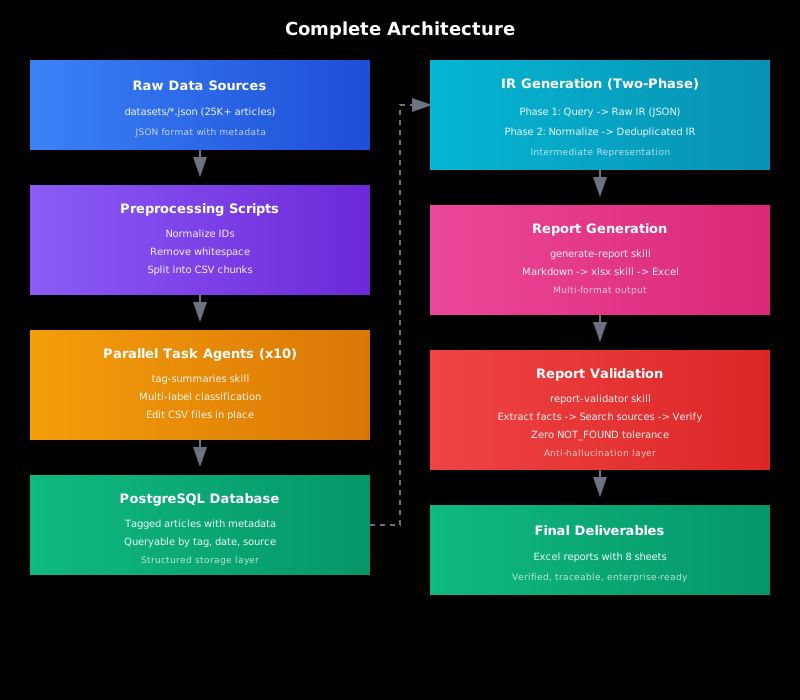
IR = Intermediate Representation. This is the key architectural pattern for reliable report generation.
这是数据处理任务的10倍并行度。Task 工具是 Claude Code 在咨询工作中最强大的功能之一。
IR 工作流模式
IR = 中间表示。这是可靠报告生成的关键架构模式。
Raw CSV Data
    ↓ [Labeling, merging, re-ranking, scoring]
PostgreSQL Database (with tags)
    ↓ [Query and filter]
IR (Intermediate Representation - JSON)
    ↓ [Normalization Task agents]
Normalized IR (deduplicated, translated)
    ↓ [Report generation scripts]
Final Reports (Markdown → XLSX/PPT/PDF)
Why IR Matters
IR provides a checkpoint between data processing and report generation:
- Auditable: IR files can be inspected before final output
- Iterative: Regenerate reports without reprocessing data
- Verifiable: Facts in reports can be traced back to IR
Two-Phase IR Generation
Phase 1: Raw IR
- Query database with tag and source filters
- Output JSON with candidate articles
Phase 2: Normalized IR
- Task agents merge duplicate topics
- Add translations (multilingual support)
- Normalize date formats (YYYY-MM-DD)
- Validate and enrich metadata
This separation prevents errors from propagating into final reports.
Report Validation: Preventing Hallucinations
The critical innovation: validate every fact in the report has a source reference.
为什么 IR 重要
IR 在数据处理和报告生成之间提供了一个检查点:
- 可审计:IR 文件可以在最终输出前检查
- 可迭代:无需重新处理数据即可重新生成报告
- 可验证:报告中的事实可以追溯到 IR
两阶段 IR 生成
第一阶段:原始 IR
- 使用标签和来源过滤器查询数据库
- 输出包含候选文章的 JSON
第二阶段:规范化 IR
- Task 智能体合并重复主题
- 添加翻译(多语言支持)
- 规范化日期格式(YYYY-MM-DD)
- 验证和丰富元数据
这种分离防止错误传播到最终报告。
报告验证:防止幻觉
关键创新:验证报告中的每个事实都有来源引用。
Report Markdown
    ↓ [Extract facts script]
.validation.json (dates, numbers, claims)
    ↓ [Parallel Task agents search sources]
Source references added
    ↓ [Verification script]
Check for NOT_FOUND entries
The report-validator Skill
A 3-step workflow:
- Extract Facts: Script parses markdown, extracts dates/numbers into
.validation.json - Fill Sources: Task agents search IR and dataset files in parallel
- Check Results: Script verifies no facts marked
"NOT_FOUND"
Smart Matching
The validator handles format variations:
- Dates: "2026-01-07", "2026/01/07", "January 7", "1月7日"
- Numbers: "1.8B" = "18亿" = "1.8 billion"
Core numeric values must exist in source, even in different formats.
Zero Tolerance
If ANY fact lacks a source reference, the report fails validation. This forces:
- Accurate transcription from sources
- No invented details
- Traceable claims
Agent Skills: Encapsulating Expertise
Claude Code skills are reusable instruction sets that encapsulate domain expertise.
report-validator Skill
3步工作流:
- 提取事实:脚本解析 markdown,将日期/数字提取到
.validation.json - 填充来源:Task 智能体并行搜索 IR 和数据集文件
- 检查结果:脚本验证没有标记为
"NOT_FOUND"的事实
智能匹配
验证器处理格式变体:
- 日期:"2026-01-07"、"2026/01/07"、"January 7"、"1月7日"
- 数字:"1.8B" = "18亿" = "1.8 billion"
核心数值必须存在于来源中,即使格式不同。
零容忍
如果任何事实缺少来源引用,报告验证失败。这强制:
- 从来源准确转录
- 不添加虚构细节
- 声明可追溯
Agent Skills:封装专业知识
Claude Code Skills 是封装领域专业知识的可复用指令集。
.claude/skills/
├── generate-report/     # Two-phase IR → Report workflow
├── tag-summaries/       # Multi-tag classification
├── report-validator/    # Fact verification
├── xlsx/                # Excel generation with formulas
└── analyze-cluster/     # Cluster metadata extraction
Key Skills for Data Analysis
generate-report: Orchestrates the full pipeline
- Phase 0: Database deduplication
- Phase 1: Raw IR generation
- Phase 2: IR normalization
- Phase 3: Markdown generation
- Phase 4: Excel export
tag-summaries: Multi-label classification
- Primary tags: market policy, opportunity, company news, competitor, industry
- Secondary tags: negative sentiment categories
- Social media tags: platform-specific variants
xlsx: Enterprise Excel generation
- Formula preservation (never hardcode calculated values)
- Error checking (zero #REF!, #DIV/0!, etc.)
- Professional styling (column widths, alignment, wrapping)
The Complete Architecture
数据分析的关键 Skills
generate-report:编排完整流程
- 第0阶段:数据库去重
- 第1阶段:原始 IR 生成
- 第2阶段:IR 规范化
- 第3阶段:Markdown 生成
- 第4阶段:Excel 导出
tag-summaries:多标签分类
- 主标签:市场政策、市场机会、公司新闻、竞品、行业
- 次标签:负面情绪分类
- 社媒标签:平台特定变体
xlsx:企业级 Excel 生成
- 公式保留(永不硬编码计算值)
- 错误检查(零 #REF!、#DIV/0! 等)
- 专业样式(列宽、对齐、自动换行)
完整架构
Key Takeaways
Reframe the problem: Data analysis becomes codebase file editing. Claude Code is optimized for this.
Chunk strategically: 200 records per file, 2000 lines max. Fits Claude Code's tools perfectly.
Parallelize with Task agents: 10x throughput for labeling, classification, and validation.
Use IR as checkpoint: Separate data processing from report generation. Enables iteration and auditing.
Validate everything: The report-validator pattern catches hallucinations before delivery.
Encapsulate in skills: Domain expertise becomes reusable, maintainable instruction sets.
The result: enterprise-quality reports from 25K+ articles, with every fact traceable to source data.
Claude Code isn't just for writing code. It's a general-purpose agent for any task that can be expressed as file operations. Data analysis is a perfect fit.
关键要点
重新定义问题:数据分析 → 代码库文件编辑。Claude Code 针对此做了优化。
策略性分块:每文件200条记录,最多2000行。适配 Claude Code 的工具。
用 Task 智能体并行化:标注、分类、验证获得10倍吞吐量。
使用 IR 作为检查点:分离数据处理和报告生成。支持迭代和审计。
验证一切:report-validator 模式在交付前捕获幻觉。
封装为 Skills:领域专业知识变成可复用、可维护的指令集。
结果:从2.5万多篇文章生成企业级报告,每个事实都可追溯到源数据。
Claude Code 不只是写代码。它是通用智能体,适用于任何可以表达为文件操作的任务。数据分析完美契合。